
Ethylene plays a vital role in the national economy and is one of the most important basic organic raw materials in the petrochemical industry. The level of ethylene production and utilization often reflects the overall development of a country’s petrochemical sector. In chemical manufacturing, the storage and transportation system of ethylene is a critical component of the raw material supply chain, providing strong support for stable and continuous plant operations.
Ethylene storage methods are generally divided into high-pressure semi-refrigerated storage and atmospheric full-refrigerated storage. Among these options, atmospheric full-refrigerated storage offers advantages such as large storage capacity, convenient transportation, high safety, and stable operation. As a result, ethylene feedstock is widely stored using atmospheric full-refrigerated tanks. Full-refrigerated tanks are mainly classified into single-containment tanks, double-containment tanks, and full-containment tanks.
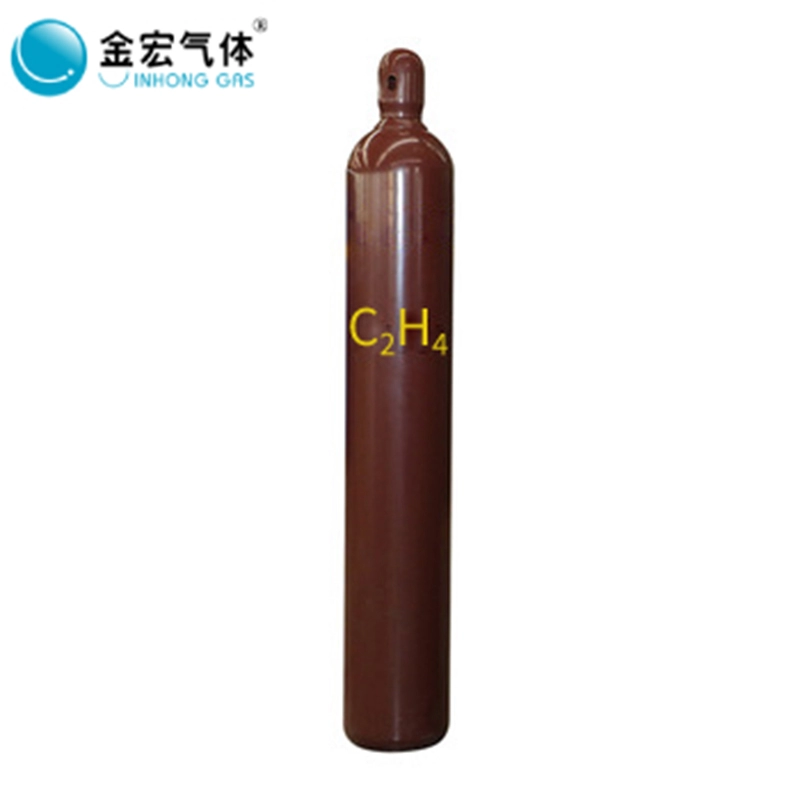
Density and Physical Properties of Ethylene (C₂H₄)
The density and physical properties of ethylene are of great importance in its storage, transportation, and industrial applications. A detailed analysis is provided below.
1. Density in the Gaseous State
Under standard conditions (0 °C, 1 atm), ethylene gas has a density of 1.178 kg/m³, equivalent to 1.178 g/L. This value indicates that ethylene is slightly lighter than air (air density ≈ 1.225 kg/m³). Therefore, when leakage occurs, ethylene tends to rise and disperse upward in the atmosphere.
Relative Density and Safety Implications
The relative density of ethylene gas compared with air is approximately 0.98 (air = 1). This characteristic has direct implications for industrial safety design. Ventilation systems must be properly engineered to prevent localized accumulation, particularly in confined or poorly ventilated areas.
2. Density of Liquid Ethylene
The density of liquid ethylene is closely related to temperature. At −103.9 °C, which is the boiling point of ethylene, the density of liquid ethylene is approximately 570 kg/m³. Compared with water (density of 1000 kg/m³ at 4 °C), the relative density of liquid ethylene is 0.61, meaning that liquid ethylene floats on water. This property is a critical consideration in the design of storage tanks and spill containment systems.
Key Properties and Storage Parameters of Ethylene (C₂H₄)
| Category | Parameter | Value / Description | Practical Significance |
|---|---|---|---|
| Basic Information | Chemical Formula | C₂H₄ | Core olefin feedstock in petrochemical industry |
| Gaseous State | Density (0 °C, 1 atm) | 1.178 kg/m³ (1.178 g/L) | Slightly lighter than air, tends to disperse upward in case of leakage |
| Gaseous State | Relative Density (Air = 1) | 0.98 | Requires proper ventilation design to prevent accumulation |
| Liquid State | Boiling Point | −103.9 °C | Determines transition between liquid and gas phases |
| Liquid State | Density at Boiling Point | ~570 kg/m³ | Important for tank design and liquid handling |
| Liquid State | Relative Density (Water = 1) | 0.61 | Liquid ethylene floats on water |
| Storage Temperature | Typical Storage Range | −169 °C to −153 °C | Maintains ethylene in liquid state for safe storage and transport |
| Phase Change Risk | Gasification Temperature | Above −103.7 °C | Rapid volume expansion may create safety risks |
| Purity Requirement | Typical Feedstock Purity | ≥99.9% | Bubble point and dew point nearly identical |
| Phase Equilibrium | Pressure–Temperature Relation | One-to-one correspondence | Enables pressure control via saturation vapor pressure |
| Storage Pressure | Tank Design Pressure | −0.0005 to 0.03 MPa(G) | Ensures safe near-atmospheric operation |
| Storage Tank Type | Common Configuration | Single-containment cryogenic tank | Inner tank stores liquid ethylene; outer tank provides support and insulation |
| BOG Handling | BOG Compression Pressure | Up to 3.9 MPa(G) | Allows re-liquefaction and pressure control |
| Re-Liquefaction | Condensation Temperature | 0 °C | Achieved using refrigerant-based cooling |
| Export Conditions | Downstream Supply Form | High-temperature, high-pressure gas | Requires pressurization, vaporization, and superheating |
| Energy Efficiency | Cold Energy Utilization | Vaporization cold energy recovered | Improves overall plant energy efficiency |
Ethylene Storage Temperature
Temperature is one of the most critical factors in ethylene storage. In general, ethylene must be stored at relatively low temperatures to maintain chemical stability. Typically, storage temperature is maintained within the liquid range of −169 °C to −153 °C (−270 °F to −245 °F). Under these conditions, ethylene remains in liquid form, facilitating safe storage and transportation.
If the temperature rises above −103.7 °C (−155 °F), ethylene transitions from liquid to gaseous state. This phase change results in a sharp volume expansion and may pose significant safety risks if not properly controlled.
Phase Equilibrium and Pressure Control of Ethylene
Feedstock ethylene typically has a purity exceeding 99.9%, approaching that of a pure component. The primary impurity is ethane, which has a similar boiling point. As a result, the bubble point and dew point of ethylene are nearly identical. When gas–liquid equilibrium is achieved, temperature and pressure exhibit a one-to-one correspondence.
Low-temperature ethylene absorbs heat from the environment and from mechanical work performed by equipment. The absorbed energy is converted into sensible heat and latent heat. Sensible heat increases the temperature of ethylene, while latent heat causes vaporization. Accordingly, the pressure control of ethylene storage tanks and vaporization pressure can be managed based on the relationship between saturated vapor pressure and temperature, as shown in the corresponding pressure–temperature reference table.
Ethylene Storage and Transportation Process Principles
Ethylene storage and transportation processes rely on the variation of bubble point or dew point at different pressures to achieve liquid storage and vapor-phase delivery. At the same time, the cold energy released during ethylene vaporization is fully utilized to improve overall plant energy efficiency.
Process Systems
1. Ethylene Unloading System
Before unloading low-temperature ethylene from ships or tank trucks, the pipelines between the jetty or unloading station and the cryogenic ethylene storage tanks must be pre-cooled. Pre-cooling is carried out using low-temperature ethylene from a pre-cooling tank or directly from the vessel or tanker truck.
Once the pipelines reach the required temperature, unloading operations can begin. During ship unloading, onboard pumps are used to pressurize and transfer ethylene into storage tanks. During truck unloading, the vehicle’s own vaporizer is used to increase pressure and deliver low-temperature ethylene to the storage tanks.
During pipeline cooling and unloading, ethylene vapor is generated due to flashing, heat absorption, vaporization, and displacement. This boil-off gas (BOG) is extracted by the ethylene BOG compressor to maintain tank pressure. After compression, the BOG is cooled in an ethylene cooler and, depending on operating conditions, either deeply condensed and returned to the tank via a condenser or routed to downstream ethylene processing units.
2. Ethylene Storage
Ethylene is stored in tanks at near-atmospheric pressure and approximately −103.7 °C. Storage tanks are equipped with level, temperature, pressure, and control systems to ensure safe and stable operation. In this process design, a double-metal single-containment tank is selected.
Both the inner and outer tanks are self-supporting steel cylindrical structures, but only the inner tank is used to store cryogenic ethylene. Ethylene vapor can be stored under the steel dome roof of the inner tank. If the inner tank is open-topped, vapor is contained within the primary liquid container surrounded by a gas-tight metal outer tank. The outer tank serves only as vapor containment, structural support, and insulation housing.
The design pressure of the storage tank ranges from −0.0005 to 0.03 MPa(G), with a design temperature of −104 °C.
3. Ethylene Gas Compression and Re-Liquefaction
During shutdowns of downstream ethylene processing units, the cryogenic ethylene tank remains in normal storage condition without inflow or outflow. When tank pressure rises, the BOG compressor is activated to extract ethylene vapor from the tank top and compress it to 3.9 MPa(G).
The high-pressure BOG is cooled to 40 °C in the ethylene BOG cooler and then sent to the tube side of the condenser. In the condenser, it is cooled by vaporizing propylene refrigerant (evaporation temperature −10 °C) on the shell side, condensing the ethylene gas to 0 °C.
The condensed liquid ethylene is collected at the bottom of the vertical condenser and returned to the top of the ethylene tank through a level control valve at 3.9 MPa(G) and 0 °C. Flash separation occurs at the tank top, with a gas-to-liquid ratio of approximately 7:3. The generated BOG is continuously extracted and recycled through the compression system.
4. Ethylene Export and Cold Energy Utilization
Ethylene is delivered from storage tanks to downstream units via external pumps. Downstream processes typically require ethylene in the form of high-temperature, high-pressure gas for chemical reactions. Therefore, exported ethylene must be pressurized, heated, vaporized, and superheated from low-temperature liquid conditions to meet the required operating parameters of the process units.
About Jinhong Gas
Jinhong Gas is a professional industrial and specialty gas supplier with extensive experience in the production, purification, storage, and distribution of high-purity gases for the chemical and petrochemical industries. We provide reliable ethylene supply solutions that comply with strict safety, purity, and temperature control requirements. Backed by advanced gas handling technology, rigorous quality management systems, and stable logistics capabilities, Jinhong Gas supports customers with safe, efficient, and customized gas solutions, helping ensure stable plant operation and long-term production reliability.
 English
 Indonesian
 Korean
 Japanese
 Malay
Malay German
 Spanish
 French
 Portuguese
 Arabic
 Italian
 Polish
 Dutch
Dutch Vietnamese
 Russian