
Noble gases—including helium, neon, argon, krypton, and xenon—belong to Group 18 of the periodic table. Under normal temperature and pressure, they exist as colorless, odorless monoatomic gases with extremely stable chemical properties. This exceptional inertness makes noble gases uniquely indispensable in semiconductor processes such as material growth, wafer cleaning, etching, and surface modification.
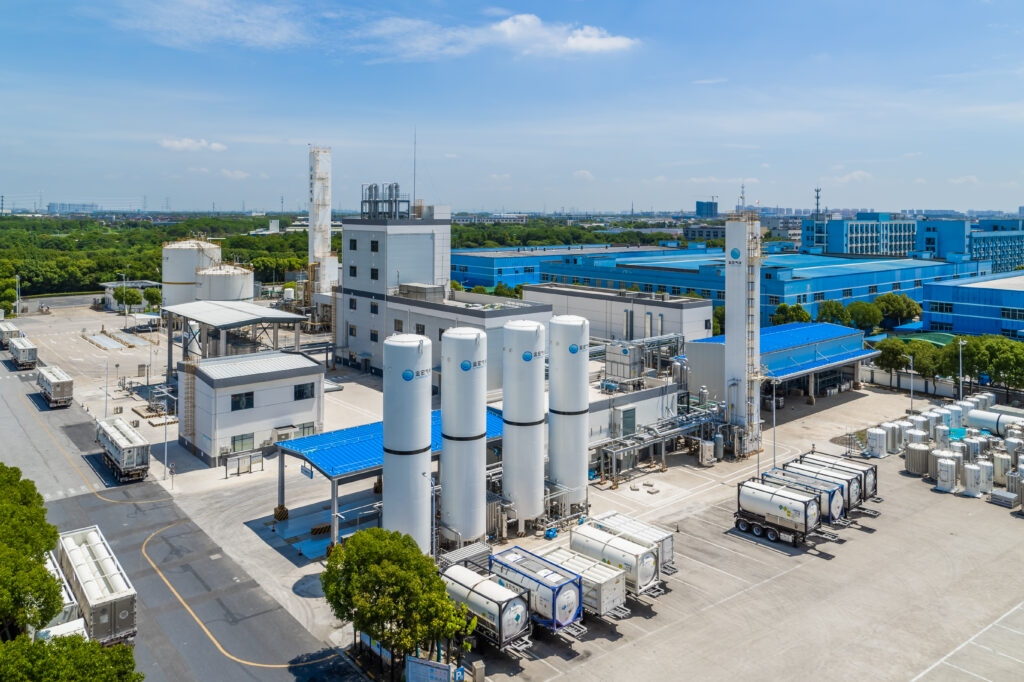
Argon serves as a representative example and is one of the most widely used noble gases in semiconductor manufacturing. During ultraviolet lithography laser deposition and etching processes, argon enables the formation of ultra-fine patterns on semiconductor chips. In high-temperature silicon crystal growth, argon functions as a protective atmosphere, preventing unwanted reactions between silicon and oxygen or nitrogen, thereby ensuring wafer purity and crystal quality. Additionally, argon provides a non-reactive environment for metal sputtering deposition and, in liquid form, is used in conjunction with precision tools to clean the smallest and most fragile semiconductor devices.
Beyond semiconductor fabrication, noble gases play essential roles in lighting, medical applications, aerospace, and advanced scientific research, continuously driving technological progress.
Key Noble Gases and Their Applications in Semiconductor and High-Tech Industries
| Noble Gas | Chemical Symbol | Key Physical Characteristics | Main Applications in Semiconductor Manufacturing | Other High-Tech Applications |
|---|---|---|---|---|
| Helium | He | Ultra-low boiling point (−268.9 °C), extremely inert | Ultra-low-temperature cooling for EUV lithography systems; carrier gas for precision instruments; leak detection in chip packaging | Rocket fuel pressurization; superconducting research; medical helium-oxygen therapy |
| Neon | Ne | Stable plasma behavior; specific optical emission wavelengths | Primary component (>96%) in ArF excimer laser gas mixtures, generating 193 nm DUV light for photolithography | Neon lighting; laser technology; optical research |
| Argon | Ar | Chemically inert; stable ionization in plasma | Plasma etching of wafers; protective atmosphere during silicon crystal growth; sputtering deposition medium; ion cleaning | Metal processing; welding; lighting; cryogenic applications |
| Krypton | Kr | High atomic mass; efficient plasma etching properties | High-aspect-ratio etching (>30:1) for advanced 3D NAND memory structures | Specialty lighting; insulation gas; scientific research |
| Xenon | Xe | Very high atomic mass; strong optical emission | Precision etching for DRAM capacitor structures; EUV plasma light source (13.5 nm) for sub-7 nm nodes | Ion propulsion for satellites; high-intensity lamps; medical anesthesia |
| Radon | Rn | Radioactive; extremely low chemical reactivity | No direct application in semiconductor manufacturing due to radioactivity | Scientific research and specialized detection applications |
Impact of Noble Gases on Technological Development
Noble gases present in air—helium, neon, argon, krypton, and xenon—support modern technology in several key areas:
- Semiconductor Manufacturing:
Argon is widely used in wafer etching processes, while helium acts as a carrier gas to ensure the stable operation of high-precision instruments. - Lighting Technology:
Xenon is used in neon and specialty lamps, krypton extends the lifespan of incandescent bulbs, and xenon enables high-brightness automotive headlights and cinema projection systems. - Medical Applications:
Helium–oxygen gas mixtures are applied in respiratory therapies, while xenon has emerged as a novel anesthetic with neuroprotective properties. - Aerospace Industry:
Helium is used in rocket fuel pressurization systems, and xenon serves as the working propellant in satellite ion propulsion systems. - Scientific Research Support:
Liquid helium enables ultra-low-temperature environments down to −269 °C, making breakthroughs in superconductivity research, particle accelerators, and other frontier technologies possible.
These characteristics establish noble gases as irreplaceable strategic resources for modern high-tech industries.
Noble gases—helium (He), neon (Ne), argon (Ar), krypton (Kr), xenon (Xe), and radon (Rn)—are chemically inert elements that are colorless, odorless, and gaseous under ambient conditions. Their inert nature makes them indispensable process media in semiconductor manufacturing:
- Ultra-Low Boiling Points:
Helium has a boiling point as low as −268.9 °C, making it the only viable option for ultra-low-temperature cooling applications. - Plasma Stability:
Argon and neon maintain stable ionization behavior in plasma environments, allowing precise control over etching processes. - Optical Properties:
Neon emits light at specific wavelengths when excited, forming the foundation for high-precision photolithography light sources.
Semiconductor manufacturing requires gas purity levels ranging from 99.999% (5N) to 99.9999% (6N), with metallic impurities controlled at the ppb (parts-per-billion) level. These stringent standards make gas production, storage, and transportation the first critical line of defense in what is often described as a “nano-scale battle” for yield and reliability.
Core Applications of Noble Gases in Semiconductor Manufacturing
1. Lithography Processes
In ArF excimer lasers, neon accounts for over 96% of the gas mixture. When excited by electron beams, this mixture generates 193 nm deep ultraviolet light, directly determining lithographic resolution. With the widespread adoption of EUV lithography, xenon plasma-generated 13.5 nm extreme ultraviolet light has become essential for manufacturing process nodes below 7 nm.
2. Etching Processes
As 3D NAND memory stack layers exceed 300 layers, krypton–fluoride gas mixtures enable etching with aspect ratios greater than 30:1, improving efficiency by approximately 40% compared with conventional gases. Xenon is used in precision etching of DRAM capacitor structures, where its high atomic mass reduces sidewall damage.
3. Cleaning and Deposition
Argon ion bombardment removes surface contaminants from wafers, achieving atomic-level cleanliness. In sputtering deposition, argon serves as the plasma medium, maintaining film uniformity deviations below 1%.
4. Cooling and Sealing
EUV lithography systems rely on liquid helium to maintain superconducting magnets at 4 K (−269 °C), with a single system consuming over 10,000 liters of helium annually. Helium leak detection technology ensures hermetic chip packaging, achieving detection sensitivity as low as 10⁻⁹ Pa·m³/s.
Extreme Challenges in Production: From Air Separation to Cylinder Filling
1. Raw Material Extraction
- Cryogenic Air Separation:
Air is compressed and cooled to −200 °C, and components are separated based on boiling point differences. Neon and helium yields are as low as 0.001%. - Off-Gas Recovery:
Argon recovery from steel plant exhaust gases reduces costs by approximately 30% compared with conventional air separation methods and has become a mainstream production route in China.
2. Purification Technologies
- Metal Impurity Removal:
Palladium membrane purifiers are used to control hydrogen permeation rates below 0.01 ppm. - Isotope Separation:
Laser excitation methods can purify helium-3 to concentrations as high as 99.95%.
3. Small Cylinder Filling and Storage
Cylinder inner-surface treatment directly determines long-term gas purity stability. Recent technological advances include:
- Inner Wall Polishing:
Electrochemical polishing reduces surface roughness to ≤0.1 μm, minimizing adsorption sites. - Passivation Treatment:
Protective films formed by passivation gases extend storage life to up to two years. - Intelligent Valves:
RFID-integrated valves enable full life-cycle tracking of cylinders, with leakage rates below 10⁻¹¹ mbar·L/s.
About Jinhong Gas
As a professional industrial and specialty gas supplier, Jinhong Gas provides high-purity noble gases and customized gas solutions for semiconductor manufacturing, electronics, and advanced industrial applications. With strong capabilities in gas purification, quality control, cylinder management, and supply chain reliability, Jinhong Gas supports customers with stable 5N–6N purity products that meet the most demanding semiconductor standards. Leveraging extensive industry experience and continuous technological innovation, Jinhong Gas is committed to becoming a long-term, trusted partner for global high-tech manufacturers.
 English
 Indonesian
 Korean
 Japanese
 Malay
Malay German
 Spanish
 French
 Portuguese
 Arabic
 Italian
 Polish
 Dutch
Dutch Vietnamese
 Russian